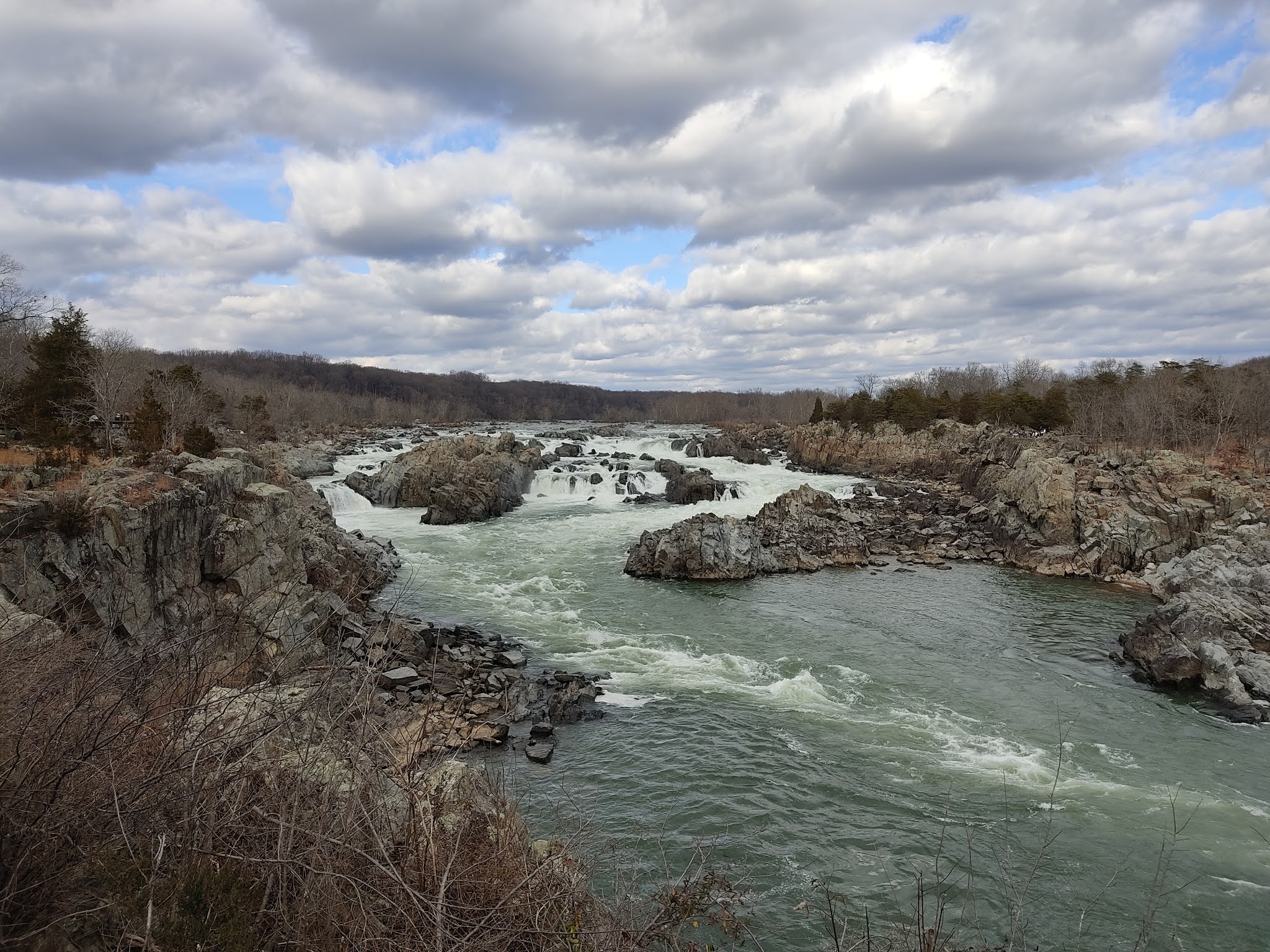

La primera visita de nuestro viaje a Virginia y a sus alrededores fue al parque nacional Great Falls. Fuimos el domingo a mediodía, antes del feriado en honor a Martin Luther King Jr., por lo que, a diferencia de lo que muestran las fotos, había mucha gente. Muchísima gente. Exagerada cantidad de gente, en especial si se toma en cuenta que estamos en plena pandemia y que lo que queríamos era estar aislados y poder conectarnos con la naturaleza. Por suerte, el río Potomac, el mismo que atraviesa Washington D.C., es suficientemente impresionante para hacerte olvidar las familias, los niños, los perros, los adolescentes, los ricos montando a caballo y la gente sin mascarillas. Mientras caminábamos no dejé de pensar en Eustace Conway, ya que estaba leyendo su biografía escrita por Elizabeth Gilbert llamada “The Last American Man”.
Desde muy pequeño, el sueño de Conway era vivir en la naturaleza, a pesar de haber nacido en una familia americana urbana de clase media. Leyendo, visitando regularmente el museo de historia natural de su ciudad y constantemente experimentando aprendió todo lo necesario para ser autosuficiente en el bosque. Por muchos años se vestía con ropa que él mismo confeccionba a base de pieles de animales, construyó su propio tipi nativo americano – respetando escrupulosamente la tradición – y vivía en él, incluso durante sus años como estudiante universitario.
Creo que sería justo de calificar a Conway como un genio, en todo el
sentido de la palabra, que logra constantemente superar sus límites físicos y
mentales guiado por una autodisciplina casi militar y por un perfeccionismo enfermizo,
producto en gran parte de una infancia difícil y de su relación tormentosa con
su padre. Sin embargo, esa combinación le ha permitido desde muy joven realizar
hazañas dignas de récords, como recorrer los 3,500 km del Sendero de los
Apalaches en apenas cuatro meses y medio, o recorrer los Estados Unidos de este
a oeste en caballo en apenas dos meses.
Conway se opone totalmente a la sociedad moderna, a su forma de vida y
de trabajo, a su consumismo incesante y a su falta de sentido. Desde siempre,
su objetivo es mostrar el ejemplo para incitar a los estadounidenses a dejar
todo y regresar a la vida elemental en armonía con los seres vivos y las
estaciones, recuperando sus capacidades físicas y produciendo y elaborando uno
mismo lo necesario para vivir. Por eso se ha dedicado a recorrer el país dando
su testimonio en escuelas, festivales y en todo tipo de eventos donde es siempre
aclamado por su increíble carisma y su filosofía radical. Su obra maestra es Turtle
Island, una reserva que compró en Carolina del Norte cuando se dio cuenta que era
cada vez más difícil vivir en el bosque a causa de la urbanización. En Turtle
Island, Conway ha construido su propia comunidad y recibe aprendices que
quieren aprender a vivir como él y que lo ayudan a cultivar verduras, criar
animales y construir estructuras.
“The Last American Man” es el segundo libro que leo sobre personas de
nuestra época que quieren conectarse de nuevo con la naturaleza como una
alternativa a la alienación que nos ofrece la sociedad moderna, basada en el
trabajo, la familia y el gobierno. Lo que quiero investigar es si acaso es
posible una forma diferente de vivir y en qué condiciones. El primer libro que
leí fue “Into the Wild” de Jon Krakauer, sobre Christopher McCandless, un joven
que después de graduarse de la universidad dejó su vida acomodada de burgués
americano buscando lo fundamental de la existencia a través de sus viajes a lo
largo de los Estados Unidos, hasta que murió solo en Alaska en 1992.
Hasta ahora, las perspectivas no son muy optimistas. O se es solitario, ingenuo
e impulsivo como McCandless y se muere en el intento, o se tiene un proyecto
muy definido de crear una nueva sociedad, pero se termina en una alienación
comparable a la que se pretendía escapar desde un inicio. Eustace Conway puede
vivir en su reserva únicamente por que la compró, lo que significa que no es
posible liberarse del sistema capitalista ni siquiera para vivir en la naturaleza.
De hecho, al terminar el libro me enteré que desde el 2012 Conway es parte del reality
show “Mountain Men” del History Channel. Me cuesta encontrar algo más alejado
de la vida auténtica que él predica que participar en un reality show. Y no veo
cuál es el interés de vivir en su comunidad si él también aniquila al individuo
con su disciplina de vida extrema y su trabajo incesante.
¿Qué podemos hacer entonces? Por los momentos, no lo sé. Seguir leyendo,
me imagino, y seguir entrando en contacto con la naturaleza, aunque sea esa
naturaleza domesticada de los senderos y de los parques, donde ni siquiera se
pueden ver animales porque saben que los humanos están allí.


Our first visit on our trip to Virginia and its surrounding states was to the Great Falls National Park. We went on a Sunday afternoon, just before Martin Luther King Jr. Day so, despite what the pictures show, there was a lot of people. Tons of people. An exaggerated amount of people, especially if you consider that we are in the midst of a pandemic and what we wanted was to be isolated and to reconnect with nature. Luckily, the Potomac, the same river that reaches Washington D.C., is impressive enough to make you forget the families, the children, the dogs, the teenagers, the rich people riding horses and the people who did not wear masks. While we were hiking, I could not stop thinking about Eustace Conway, since I was reading his biography written by Elizabeth Gilbert entitled “The Last American Man”.
Since he was a child, Conway’s dream was to live in nature, even though he was born in a middle class urban American family. By reading, regularly visiting his hometown’s museum of natural history and constantly experimenting, he learned all that is necessary to be self-sufficient in the woods. For many years, he wore clothes he made by himself with animal skins, he built his own Native American teepee – which thoroughly respected tradition – and he lived in it, even during his time as a college student.
I think it would be fair to describe Conway as a genius, in all the
sense of the term, who constantly surpasses his physical and mental limits, guided
by an almost military self-discipline and by neurotic perfectionism, the product
in part of a difficult childhood and of his troubled relationship with his
father. However, this combination has allowed him to accomplish record-worthy
feats since he was young, such as hiking the entire 3,500 km of the Appalachian
Trail in just four months and a half, or horse riding from east to west of the
entire United States in barely two months.
Conway is totally opposed to modern society, to its form of life and
work, to its incessant consumerism and its lack of meaning. Since always, his
objective is to lead by example and encourage Americans to leave everything and to
come back to a more elemental way of life in harmony with all living beings and
seasons, to recover their physical abilities and to produce themselves all that
is necessary to live. That is why he has devoted his life to travel around the
country giving his testimony is schools, festivals and all sorts of events, in
which he is always acclaimed for his incredible charisma and radical
philosophy. His masterpiece is Turtle Island, a reserve he bought in North
Carolina once he realized that it was increasingly harder to live in the woods
because of urbanization. In Turtle Island, Conway has built his own community
and hosts apprentices who want to learn to live like him and who help him in
farming vegetables, raising animals and building structures.
“The Last American Man” is the second book I read on people of our time
who aim at reconnecting with nature as an alternative to the alienation of
modern society based on work, family and government. What I want to find out is
whether there is a different way to live and on what terms. The first book I
read was “Into the Wild” by Jon Krakauer, on Christopher McCandless, who after
graduating from college left his comfortable bourgeois American life in search of
the fundamental existence through his travels across the United States, until
he died alone in Alaska in 1992.
Until now, the perspectives are not very optimistic. Either you are
solitary, ingenuous and impulsive, like McCandless, and you die while trying,
or you have a well-defined project of a new society, but you end up in an
alienation comparable to the one you were looking to escape to begin with.
Eustace Conway can live in his reserve only because he bought it, which means
that it is not possible to free oneself from the capitalist system not even to
live in nature. In fact, once I finished the book I learned that Conway is part
of the reality show “Mountain Men” in the History Channel, since 2012. I am
having trouble finding something farther away to the authentic life he preaches
than to participate in a reality show. And I do not see the interest in living
in his community if he also annihilates the individual with his extreme life
discipline and incessant work.
What can we do then? For the moment, I don’t know. Keep reading, I guess,
and keep reaching out to nature, even to this domesticated nature of trails and
parks, where you cannot even see animals because they know humans hang there.


La semana pasada Jacques y yo nos fuimos de
viaje con dos amigos al estado de Virginia y sus alrededores. Originalmente
teníamos pensado asistir a la inauguración de Joe Biden, pero obviamente
después de los disturbios del 6 de enero eso quedó descartado. Encima de eso,
el contexto actual no es el ideal para este tipo de aventuras, pero tratamos de
ser lo más cuidadosos posible. Para empezar, los cuatro trabajamos o pasamos
prácticamente todo el tiempo en casa, sin ninguna interacción con otras
personas. Nos fuimos en el carro de nuestros amigos y alquilamos una casa solo
para nosotros en un complejo llamado “Blue Ridge Center”, que cuenta con una
granja pedagógica y un bosque adyacente al “Appalachian Trail”, un sendero de
casi 3,500 km entre Georgia y Maine. En todo el viaje fuimos solo a dos
restaurantes en los que casi no había gente porque llegamos temprano y en los
cuales tenían las mesas muy alejadas entre ellas. El resto del tiempo comimos
en el exterior. Y obviamente usamos mascarillas todo el tiempo, como la mayoría
de la gente que cruzamos.
Tuvimos la doble ventaja que uno de nuestros
amigos vivió por cinco años en Washington D.C., por lo que conocía muy bien la
región. Encima de eso es arqueólogo y trabaja para el servicio de protección
del patrimonio, así que nuestro viaje fue muy educativo. Nos llevó a sus
lugares favoritos, entre ellos una iglesia de inicios del siglo XX remodelada
en restaurante ultra hípster y un restaurante de mariscos extraordinario, donde
hasta yo – conocida mundialmente por detestar los mariscos – los disfruté.
Fuimos también a lugares turísticos, como el parque nacional Great Falls o Mt.
Vernon, que es la mansión de George Washington, y a otros mucho menos
conocidos, como el pintoresco pueblo de Waterfront y las residencias situadas
justo detrás del Capitolio en D.C.
El viaje fue un completo festín visual. A pesar
de que cuando se trata de propiedades privadas la conservación del patrimonio
no es una obligación legal en los Estados y depende de la voluntad de los
dueños, los pueblos que visitamos están muy bien conservados. Vimos hermosas
casas del periodo colonial y del siglo 19, muy variadas entre ellas y aún así
conservando una cierta unidad en los conjuntos. Desde siempre me ha gustado ver
casas e imaginar en cuál me gustaría más vivir, así que por primera vez me
presté al ejercicio de visualizarme viviendo en un bonito pueblito de los
Estados Unidos. Y pude observar la línea muy tenue que existe entre preservar
la integridad de un pueblo, como Waterfront que protege hasta los antiguos
terrenos agrícolas para evitar nuevas construcciones, y entre caricaturizarla
con fines turísticos à la Disneyland,
como en Leesburg, Virginia, donde todo se ve tan limpio y tan nuevo que se
siente falso.
Como podría esperarse, se necesita un carro
para moverse entre ciudades y pueblos, y a veces hasta para visitar zonas
naturales protegidas, lo que me parece totalmente incoherente. Por ejemplo, fuimos
al refugio de Blackwater en Maryland, una región pantanosa donde viven muchas
especies animales, entre ellas el famoso águila de cabeza blanca. Pues el
principal sendero de visita es en carro y los senderos peatonales que tienen
solo son de uno o dos kilómetros. De por sí que el acceso a la naturaleza ahora
está súper controlado en los parques donde uno puede caminar, pero si encima ni
siquiera se puede salir del carro, no creo que tenga gran interés.
Tengo que decir que aprendí mucho de la historia de los Estados Unidos en este viaje. De hecho, me di cuenta de lo poco que sabía de este país, a pesar de haber siempre vivido constantemente bombardeada por su cultura. Su guerra de independencia, su guerra civil, todo eso me parecía tan abstracto, hasta que visitamos la casa de Washington, o el museo en Harpers Ferry, West Virginia dedicado a John Brown, defensor de la abolición de la esclavitud. Muchas de esas heridas están lejos de haberse sanado, como lo muestran la cantidad enorme de casas que tenían rótulos en sus jardines de “Black Lives Matter”, anunciando explícitamente que son defensores de los derechos LGBTQ o de los inmigrantes, o simplemente pro-Trump o pro-Biden. Este es realmente un país lleno de contrastes y en esos lugares tan bonitos que visitamos uno se siente totalmente desconectado de las injusticias que se viven en otras zonas o uno olvida fácilmente cómo toda esa prosperidad está basada en la explotación de las minorías y de los países tercermundistas. Solo para no olvidar eso, lo primero que hice al regresar a casa fue empezar el libro “The Undocumented Americans”, de Karla Cornejo Villacencio.


Last week, Jacques and I travelled with two
friends to Virginia and its neighboring states. Originally, we planned on going
to Biden’s inauguration, but obviously after the riots at the Capitol on
January 6th, this was not possible anymore. Besides, the current
context is not the ideal for this type of adventures, but we tried to be as
cautious as possible. First, all four of us work or spend practically all time
at home, with no interaction with other people. We also travelled on our
friends’ car and we rented a house solely for us in a complex called the “Blue
Ridge Center”, which has a farm and is surrounded by a forest adjacent to the
“Appalachian Trail”, which spans close to 3,500 km from Georgia to Maine.
During the entire trip, we only went to two restaurants where there were not
many people because we arrived early and where they also had the tables far
away from each other. The rest of the time we ate outside. And obviously we
used face coverings all of the time, as most of the people we saw.
We had the double advantage that one of our
friends lived in Washington D.C. for five years, so he knew very well the
region. He is also an archaeologist and works for the heritage protection
service, so our trip was very educational. He took us to his favorite places,
among them a former church from the early 20th century refurbished
into an ultra-hipster restaurant, and an extraordinary seafood restaurant,
where even I – famous worldwide for my aversion to seafood – enjoyed them. We
visited very touristic places too, such as the Great Falls National Park, or
Mt. Vernon, which was George Washington’s plantation, and other less known, as
the picturesque town of Waterfront and the houses located right behind the
Capitol in D.C.
The trip was a complete visual feast. When it
comes to private properties, heritage preservation is not a legal obligation in
the US and it depends on the will of the owners, and yet the towns we visited
are extremely well preserved. We saw beautiful houses from the colonial period,
others from the 19th century, all very different between them and
yet achieving a certain unity in the ensembles. I have always enjoyed looking
at houses and picturing living in my favorites, so for the first time I
imagined what it would be like to live in a charming town in the US. And I
could observe the thin line that exists between preserving the integrity of a
village, like Waterfront that protects even its former agricultural land to
prevent new constructions, and turning it into a caricature for touristic
purposes à la Disneyland, like in
Leesburg, Virginia, where everything looks so clean and new that it feels fake.
As expected, you need a car to go from one town
to another, and sometimes even to visit protected natural zones, which I think
is totally incoherent. For example, we went to the Blackwater Refuge in
Maryland, a swamp region with many animal species, including the famous
American bald eagle. Its main trail can only be visited by car and the
pedestrian trails are only one or two kilometers long. Nowadays, the access to
nature is very controlled in parks where you can walk, so I do not see the
point in not being able to leave the car.
I must say that in this trip I learned a lot on
the history of the US. In fact, I realized how little I really knew of this
country, despite having lived constantly bombarded by its culture. Its
independence and civil wars always seemed abstract, until we visited Washington’s
house, or the museum in Harpers Ferry, West Virginia, dedicated to John Brown,
abolitionist leader. Many of those wounds are still far from healed, as proven
by the innumerable houses with “Black Lives Matter” signs in their front lawns,
or explicitly announcing that they are in favor of LGBTQ or migrant rights, or
simply pro-Trump or pro-Biden. This is really a country full of contrasts and
in these beautiful places we visited one feels utterly disconnected from the
injustices in other zones or one easily forgets that all this prosperity is
based on the exploitation of minorities and of third world countries. Just so I
did not forget that, the first thing I did back home was to start reading “The
Undocumented Americans”, by Karla Cornejo Villacencio.



Nunca he entendido a la gente que dice que le gusta el otoño o el
invierno. Hace frío, llueve mucho y el cambio de color en las hojas de los
árboles no tiene ningún impacto positivo en mi estado de ánimo. Lo único bueno
del otoño es que en la tele pasan “Le Meilleur Pâtissier”, la versión francesa
de “The Great British Bake Off”, un concurso de aficionados a la pastelería.
Cada semana, los participantes preparan un pastel o un postre en cada
una de las tres pruebas temáticas. La primera es el “Signature Bake”, en el que
reinterpretan un clásico de la pastelería. El segundo es el “Technical
Challenge”, en el que se da una receta a los participantes – con algunas
omisiones intencionales – generalmente de un pastel poco conocido o de
elaboración muy compleja y que es juzgado a ciegas por los jueces, es decir sin
saber quién lo realizó. La prueba final es el “Showstopper”, en el que cada
participante inventa un pastel con la intención de impresionar a los jueces.
Las semanas son temáticas, en el Reino Unido los temas son los tipos de
pasteles, de postre o de técnicas que se van a emplear, por ejemplo, una semana
está dedicada a las tartas, otra al pan, etc. En Francia, los temas no tienen
que ver con la técnica sino con la inspiración que deben tener los pasteles. En
la más reciente temporada hubo un episodio inspirado en Indiana Jones, otro en
los Estados Unidos, otro en la India y en los últimos años se ha vuelto
recurrente un episodio basado en “50 Shades of Grey”.
Sin embargo, la diferencia más importante entre las dos versiones del
programa es que en la británica algunas de las pruebas son para platos salados,
mientras que la francesa se dedica exclusivamente a preparaciones dulces. Yo
descubrí la versión británica mucho después de la francesa, así que me sorprendió
mucho ver a los participantes cocinando carne entre dos pasteles, pero ambos
resultados son igual de impresionantes y se ven exquisitos.
Los participantes son de todas las edades, desde jóvenes de menos de 20
años en algunas ocasiones, a personas mayores, y se dedican a todo tipo de
oficios. Recuerdo un participante que era guardia en una prisión. No me puedo
imaginar el contraste que debió existir entre su trabajo y entre la delicadeza
de sus pasteles semana tras semana.
Sin importar que los participantes vean la pastelería como un
pasatiempo, las pruebas que deben enfrentar requieren un conocimiento y manejo
muy preciso de varios métodos, algunos realmente complicados. No solo eso,
tienen que ser muy creativos, tanto en los sabores como en la presentación para
poder impresionar a gente del calibre de los jueces.
En las dos versiones, hay dos jueces escogidos según la fórmula de un
chef joven y una pastelera mayor. En Francia son Cyril Lignac, un chef
pastelero muy carismático y popular en el país y que salió un tiempo con Sophie
Marceau, y Mercotte, autora de libros de cocina y pastelería y presentadora de
un programa de radio sobre gastronomía. En el Reino Unido, los jueces son Paul
Hollywood, chef pastelero, y Mary Berry, autora de numerosos libros de
pastelería. Debo confesar que prefiero de lejos a los presentadores franceses,
que son mucho más calurosos y divertidos que los británicos. Tanto estos
últimos como los franceses son muy exigentes, pero Paul y Mary muchas veces
saben que los participantes se equivocan en algo y no se lo dicen, o les cuesta
mucho reconocer que algo salió bien, en especial a Paul. Y tengo un lugar
especial en mi corazón para Cyril Lignac que tiene un restaurante, una
pastelería y una repostería situados a cinco minutos de mi antiguo trabajo en
París. Muy seguido me podían encontrar los viernes comiendo en el parque de al
lado uno de sus “baba au rhum”, un pastelito empapado de ron y con crema en
medio. Y su “pan aux raisins”, un simple caracol con pasas, fue una revelación
que no he podido encontrar en ninguna otra parte.
A los jueces se suma una presentadora en Francia, y dos en el Reino
Unido, Mel y Sue, por lo menos hasta las temporadas que produjo la BBC y que
son las que yo he visto. Desde el 2016, el programa fue comprado por otro
canal, pero ya no cuenta con Mary Berry ni con Mel ni Sue, pero me he negado a
verlas por miedo a decepcionarme.
Lo que más me gusta de este programa es que, a pesar de ser una
competencia, después de cada episodio uno termina con una fe renovada en la
humanidad. Con el tiempo, uno aprende a conocer a los participantes, sus
habilidades y personalidades, y todos se ayudan entre ellos y terminan formando
un grupo muy unido. Además, descubrí la versión británica del programa justo en el periodo en el que estaba terminando mi tesis y buscando trabajo.
Todo parecía incierto y difícil y este programa fue una verdadera sopa de pollo
para mi alma de millenial.
Me encanta ver que los jóvenes sean particularmente buenos y por eso me
alegró mucho que las dos últimas ganadoras en Francia son muchachas jóvenes a
las que estoy segura este concurso les va a abrir nuevas oportunidades
profesionales. Pero aun los participantes que no aspiran a ser profesionales son
capaces de expresar sus personalidades en sus creaciones, aprenden y mejoran
con cada prueba y por ende tienen mucho que enseñarnos con respecto a la
dedicación y a la resiliencia.
Tengo que decir que el programa no me ha inspirado particularmente a
dedicarme a la pastelería, más bien lo contrario, sobre todo porque veo lo
increíblemente técnica que es y todo lo que puede salir mal. Todavía tengo
grabado en mi mente el fiasco de la vez que traté de hacer rollos de canela
caseros. Pero con Jacques agarramos la costumbre de comprar pasteles para ver
el programa todos los miércoles, lo que me parece más que suficiente por los
momentos.
I have never understood people who love fall or winter. It is always
cold, it rains constantly and the changing colors in the leaves have no
positive impact whatsoever on my mood. The only good thing about the fall is
that it brings with it a new season of “Le Meilleur Pâtissier”, the French
version of “The Great British Bake Off”, a competition of baking aficionados.
Each week, contestants prepare a cake or dessert in each of the three
themed challenges. The first is the “Signature Bake”, in which they reinterpret
a classic preparation. The second is the “Technical Challenge”, for which
contestants receive a recipe – with intentional omissions – of what is
generally a fairly obscure or very complex cake. Judges taste it blindly,
without knowing which participant made it. The final test is the “Showstopper”,
in which each contestant is free to invent a cake intended to impress the judges.
Every week is also themed; in the UK they are based on types of cakes, desserts
or techniques, such as pastry or bread week. In France, themes are not related
to technique but to the inspiration that cakes should have. For instance, in
the latest season there were episodes inspired by Indiana Jones, the USA, and India,
and “50 Shades of Grey” has become a recurrent one for two or three years now.
However, the most important difference between the two versions of the
show is that the British one includes savory dishes, whereas the French one is entirely
devoted to sweet ones. I discovered the British version way after the French, so I
was really surprised to see the contestants cooking meat in between two cakes,
but both results are equally impressive and seem delicious.
Contestants range in all ages, from those younger than 20 years old, to
much older ones, and they come from all types of professions. I remember that
one time there was a prison guard. I cannot imagine the contrast that must have
existed between his work and the finesse of his bakes week after week.
Even though this is just a hobby for the contestants, the challenges
they face necessitate a precise and extensive knowledge and mastery of various
methods, some of them really complex. Not only that, they must be extremely
creative, both in terms of flavor and presentation to be able to impress people
of the caliber of the judges.
In both versions, there are two judges selected according to the formula
of a young chef and an older baker. In France they are Cyril Lignac, an
extremely charismatic and popular pastry chef who dated Sophie Marceau, and
Mercotte, author of cooking and baking books and host of a radio show on
gastronomy. In the UK, the judges are Paul Hollywood, pastry chef, and Mary
Berry, author of numerous books on baking. I must admit I prefer by far the French
hosts, who are much warmer and funnier than the British ones. They all have
very high standards, but Paul and Mary sometimes know when the contestants are
making a mistake and do not tell it to them, or they have a hard time telling
them when they did good, especially Paul. Besides, I have a special place in my
heart for Cyril Lignac who has a restaurant and two bakeries five minutes away
from my old job in Paris. You could often find me eating a “baba au rhum”, a
cake drenched in rum and with cream in the middle in the park next door on
Fridays. And his “pain aux raisins”, a simple spiral pastry with raisins, was a
revelation that I have not been able to find elsewhere.
In addition to the judges there is also a host in France and two in the
UK, Mel and Sue, at least in the seasons produced by the BBC, which are those I
have watched. Since 2016, the show was bought by another channel, but it no
longer features Mary Berry nor Mel or Sue, so I refuse to watch them for fear of
being disappointed.
What I like the most about this show is that, even though it is a
competition, after each episode you end up with a renewed faith in humanity. With
time, you get to know the contestants’ abilities and personalities, and they
all help each other and form a united group. Furthermore, I discovered the British
version right at the time that I was finishing my dissertation and
looking for a job. Everything seemed uncertain and difficult and this show was
a truly chicken soup for my millennial soul.
I love watching young contestants who are talented and I was really
happy that the two latest winners in France are young women for whom the show
will truly open new professional opportunities. But even the contestants who do
not aspire to become pros are capable of expressing their personalities in
their creations, they learn and improve with each challenge and thus have much
to show us in respect to dedication and resilience.
I must say, however, that the show has not inspired me to take on baking,
quite the opposite, since I can see how technical baking is and the many things
that can go wrong. Plus, I still have on my mind the fiasco of when I tried to
make homemade cinnamon buns. But with Jacques we started buying pastries to watch
the show each Wednesday, which I think is enough for now.

El torbellino de la pandemia me arrastró a mi también y me dejó allí donde nunca pensé aterrizar, en los Estados Unidos. Llegué hace tres semanas, después de más de siete años seguidos de no vivir en el continente americano y más de tres de no haberlo visitado. Hablar de shock cultural sería un eufemismo, ya que todo me parece grande y diferente, pero al mismo tiempo muchas cosas me recuerdan a Honduras y tengo que confesar que me siento un poco como en casa.
Después de más de
un año de vivir en París, me encuentro ahora en la ciudad de Columbia, en el
estado de Missouri. Está situada entre St. Louis y Kansas City, cada una a dos
horas, y al sur de Chicago que está a seis horas en carro. Es una ciudad
pequeña construida en torno a la universidad, que por una de esas casualidades
de la vida, tiene su propio reactor nuclear con un departamento de arqueometría,
por lo que Jacques trabaja aquí. Por todas partes se ven carteles de los
“Tigers”, el emblema de la universidad, y gente vestida con sus colores, negro
y amarillo.
Ya fui al
“centro” de la ciudad, compuesto de dos calles perpendiculares con algunos
comercios y restaurantes cerrados por la pandemia. Es más pequeño de lo que me
atrevo a aceptar. El resto de la ciudad está disgregado por calles súper
amplias, con acera casi inexistentes, para llegar a centros comerciales por
todas partes, en carro por supuesto. Hay un sistema de transporte público, pero
está compuesto por seis líneas de bus, con un bus cada una (!!), que hacen un
recorrido de 45 minutos a los diferentes ejes de la ciudad pero que se unen
todos en el mismo lugar para luego volver a empezar. Eso quiere decir que si
uno pierde el bus, tiene que esperar 45 minutos para que vuelva a llegar. No
tiene horarios, pero hay una aplicación en el teléfono que te permite saber
adónde está el bus que te interesa. Solo la gente de bajos recursos, y los
extranjeros despistados, usan el bus. Con el covid, lo han puesto gratuito,
pero los choferes bloquean el acceso a la parte delantera del bus para no
entrar en contacto con los pasajeros.
Así que Jacques y
yo andamos principalmente en bicicleta. En cuanto llegué, me suscribí a varias
páginas de facebook de organizaciones locales, entre ellas el departamento de
parques y de recreaciones, que maneja entre otras cosas los senderos de
excursión. Justo en esos días, una asociación que colabora con ellos tenía una
venta de bicicletas de segunda mano, así que hicimos cita para ir a verlas.
Resulta que la asociación tiene por objetivo favorecer el transporte en
bicicleta, como una alternativa al carro, en especial para las clases
populares. Ofrece entonces reparaciones gratuitas de las bicicletas y
ocasionalmente hace ventas como esa. Encontré la mía y hasta me regalaron una maletita y un foco. Así que nos pueden encontrar con nuestras
bicis entre los pick-ups gigantescos, aunque todavía me tengo que acostumbrar a
estar rodeada de carros y tengo que mejorar considerablemente mi condición
física y eso que aquí no hay cuestas. Pero el otro día fui sola al centro
comercial más cercano, a unos diez minutos de donde vivimos, y lo consideré
como el primer gran éxito de mi estadía aquí.
Nuestro primer domingo, Jacques me llevó a uno de los “trails”, los senderos de excursión que rodean la ciudad. El que tenemos cerca es el MKT, el que conecta los estados de Missouri, Kansas y Texas, lo que da una idea de su distancia. Atraviesa bosques y ríos, pero el sendero está perfectamente definido y mantenido y tiene en varios puntos estacionamientos, baños, fuentes de agua y otros servicios, por lo que se ve varia gente caminando, corriendo o en bicicleta. Me encantó ese paseo y me muero de ganas de hacer más excursiones. Nunca me imaginé que de todos los lugares del mundo, era en los Estados Unidos que iba a tener la oportunidad de conectarme con la naturaleza. Pero ese es apenas el primero de muchos prejuicios que tengo sobre este país que voy a tener que enfrentar en los próximos 10 meses.

After more
than a year of living in Paris, I am now in the city of Columbia, in the state
of Missouri. It is located between St. Louis and Kansas City, both two hours
from here, and south of Chicago, which is a six-hour car ride away. It is a
small town built around the university, which somehow has its own nuclear
reactor and department of archaeometry, which is why Jacques works here.
Everywhere you go you find billboards of the “Tigers”, the university’s emblem,
and people dressed up in its colors, black and yellow.
I have
already been to the “city center”, which is just two perpendicular streets with
some shops and restaurants closed because of the pandemic. It is smaller than
what I am ready to accept. The rest of the city is disintegrated by wide
streets, with almost non-existent sidewalks, to reach ubiquitous shopping
centers, by car of course. There is public transportation, but it is formed by
six bus lines, with one bus each (!!), which makes a 45-minute loop towards the
city’s different axes, ending all together in the same spot before starting again.
This means that if you miss the bus you need to wait 45 minutes for it to come
again. There are no schedules, but there is an app to see where the bus you are
interested in is at the moment. Only poor people, and clueless foreigners, take
the bus. Because of covid, it is free right now, but the drivers block the
front access so that they have no contact whatsoever with the users.
So Jacques and I use mainly the bike. As soon as I got here, I subscribed
to many facebook pages of local organizations, among them the parks and
recreation, which handles the excursion trails. Those days, an association that
works with them was organizing a sale of secondhand bicycles, so we made an
appointment to go see them. The association promotes transportation by bike, as
an alternative to the car, especially for working-class people. It thus offers
free repairs and occasionally organizes sales such as this one. I found my bike
and they even gave me a small case and a lamp. So you can find us biking next
to the huge pick-ups, even though I still have to get used to being surrounded
with cars and I definitely need to improve my physical condition. But the other
day I went by myself to the closest shopping center, located close to 10
minutes away from where we live, and I considered it the first important
achievement of my stay here.
Our first Sunday, Jacques took me to one of the trails that surround the city. The one next to our place is the MKT, which connects the states of Missouri, Kansas and Texas, which can give you an idea of how long it is. It goes through forests and rivers, but the trail is perfectly defined and maintained and it has parking spaces, bathrooms, water fountains and other services in many points, so you see a lot of people walking, running or biking. I loved that stroll and I cannot wait to discover other trails. I never thought that in all places in the world, it was in the USA that I would have the opportunity to connect with nature. Yet this is barely the first of many prejudices I have about this country that I will have to face in the next 10 months.

Hace poco tuve la oportunidad de platicar con la gente increíble que maneja la página "Becas para Hondureños" sobre mi experiencia como becaria en Suiza.
Probablemente suene arbitrario comparar “After” (2019) y “Before Sunrise” (1995) por la única razón que son dos películas que vi este fin de semana, pero en realidad las dos tratan del encuentro de dos desconocidos que se enamoran durante los primeros años de la vida adulta. La comparación se termina allí, porque los quince años que las separan no solo se traducen en ropas y peinados diferentes, pero en dos visiones totalmente opuestas de cómo piensan y actúan los jóvenes y de las cosas que los preocupan. Odio tener que ser la persona irritante que dice que todo era mejor antes, pero es indignante ver lo que los años 2000 han hecho con las películas para adolescentes/jóvenes adultos. Y ya es hora de que los adolescentes y jóvenes adultos protesten contra tanta basura.
It may sound arbitrary to compare “After” (2019) and “Before Sunrise” (1995) for the sole reason that they are two movies that I watched this weekend, but they both deal with the encounter of two strangers who fall in love during the early years of adulthood. The comparison ends there because the fifteen years that separate them are manifest not only in the different clothes and hairstyles, but also in two opposite visions of how young people think and act and the things that worry them. I hate to be that annoying person who claims that everything was better before, but it is infuriating to see what the 2000’s has done to teenage/young adult movies. And it is time for teenagers and young adults to protest against that crap.

Antes que nada, quería precisar que ante la evidente falta de motivación que tengo de diseccionar mi vida en este blog (y en cualquier otro medio de hecho, últimamente ando como el emoticon del monito que se cubre los ojos más o menos riendo), he decidido dedicarlo principalmente a hacer reseñas de libros que he leído, series o películas que he visto, exposiciones que haya visitado, o comidas que haya probado.
Así que mi intención inicial el día de hoy era escribir sobre la temporada 9 de The Walking Dead, que terminé ayer y me gustó mucho. Pero después de pasar todo el día descifrando los misterios de Revit, el súper programa que usan todos los arquitectos ahora, decidí darme una merecida pausa con un episodio de “Gourmet Makes”, un programa en YouTube creado por la revista de cocina “Bon Appétit”. Desafortunadamente para mí, solo me faltaba un episodio de los 15 que ya han sido difundidos, pero eso solo muestra cuánto me ha gustado el programa. La recomendación era inevitable.
First of all, I want to make clear that in light of the evident lack of motivation I have been feeling for dissecting my life for this blog (or for any other media for that matter, lately I feel like the emoticon of the monkey who covers his eyes while laughing, sort of), I have decided to dedicate it mainly to reviews of books I have read, series or movies I have watched, exhibitions I have visited, or foods I have tasted.
So today, mi initial intention was to write about season 9 of The Walking Dead, which I finished yesterday and enjoyed a lot. But after spending the entire day deciphering the mysteries of Revit, the super program that all architects use nowadays, I decided to take a well-deserved break with an episode of “Gourmet Makes”, a show in YouTube created by the food magazine “Bon Appétit”. Unfortunately for me, I only had one episode left of the 15 that have aired until now, but this only shows how much I like the show. The recommendation was thus inevitable.

Social Icons